
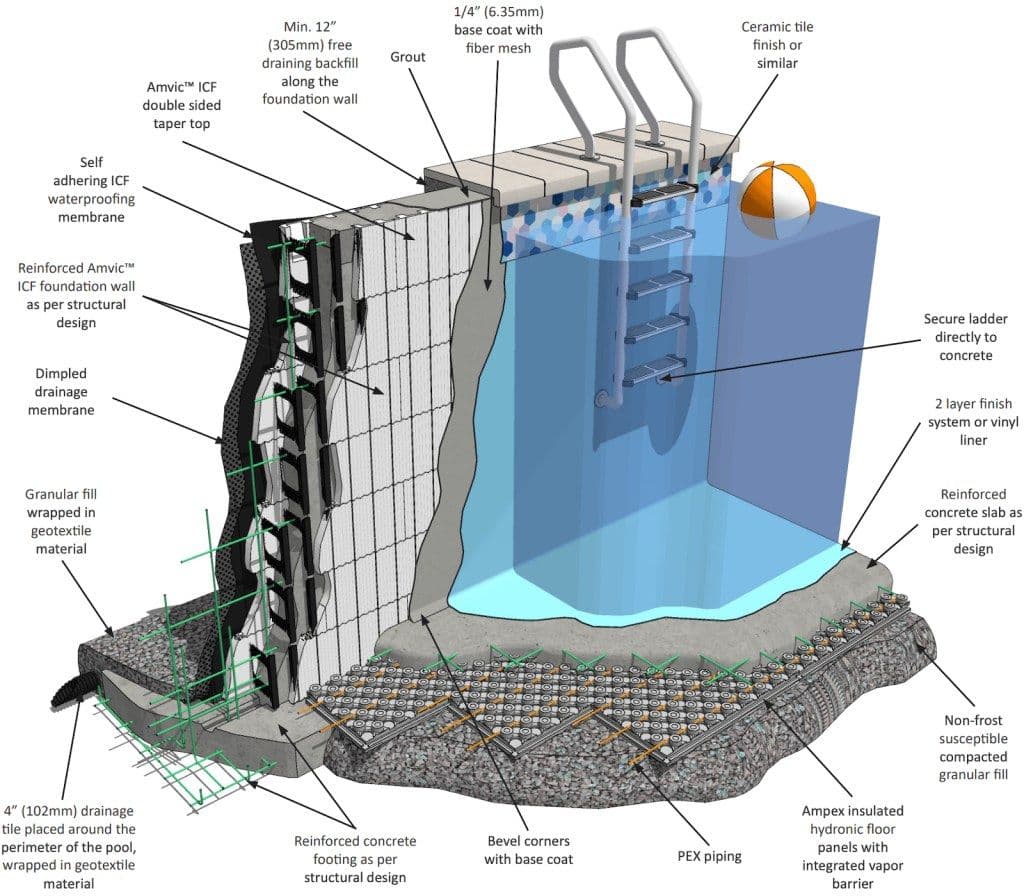
What is an ICF pool?
ICF stands for insulated concrete forms. Home builders have used them for foundations and walls for years. The forms are hollow blocks of rigid foam that stack together like oversized building bricks. Once they are up and braced, steel rebar goes inside and concrete is poured into the cavity. The foam is not stripped off afterward the way wood or steel forms are. It stays on both faces of the wall as permanent insulation.
For a pool, that gives you a reinforced concrete wall with a foam jacket around it. The U.S. Department of Energy describes ICF walls in houses as having high thermal resistance, typically around R-20. Bare concrete, by comparison, is a poor insulator. It moves heat readily in both directions, and in an Ohio backyard the direction it moves is usually out of the pool and into the ground.
We also build gunite pools when someone asks for one. Most of the time, though, if a family wants concrete, we steer them to ICF.
Why the insulation matters on Ohio ground
Water is heavy and holds a lot of heat, but it gives that heat up to whatever it touches. A pool loses heat from the surface to the air, which is what a cover is for. It also loses heat through the walls and floor to the soil around it. Here that soil is mostly glacial till, clay and silt packed tight, and in many yards it stays wet well into spring. The USDA soil survey for Mahoning silt loam, one of the most common soils on the till plains of Northeast Ohio, notes a perched water table 6 to 12 inches down for much of the year. Wet, cold clay pulls heat out of a concrete wall steadily.
Foam on the outside of the wall slows that down. In practice it means a heater does less work in May and September, and the water stays closer to where you set it after a cool night. It will not turn an Ohio pool into a Florida pool. Pair it with a heater and a good cover, though, and you get a few more weeks at each end of a season that otherwise runs roughly Memorial Day to Labor Day.
When we recommend ICF instead of fiberglass
We build more fiberglass pools than anything else, and for most yards we think it is the right call. ICF is the answer when fiberglass cannot do what you want. The common reasons we hear:
- You want a shape nobody makes in a mold, such as a pool that follows a curved patio, a geometric pool that lines up with the back of the house or an L shape with a separate shallow end.
- You want something wider than 16 feet or longer than 40, the upper limit of the fiberglass shells we install.
- You want a specific depth profile, a long shallow area for young kids or a lap lane of a set length.
- The pool has to fit a tight or odd lot, where a factory shell would either not fit or would waste space.
- You care most about heat retention and plan to swim early and late in the season.
ICF also gets around one practical problem. A fiberglass shell arrives on a truck and goes in with a crane, so the crane needs somewhere to set up. ICF blocks are light and need no heavy equipment to deliver or lift, which helps on lots where the backyard is hard to reach.
ICF is a custom build, and it takes longer on site than setting a shell. If a Liberty model fits your yard and your plans, fiberglass will usually get you swimming sooner. We will tell you which way we would go and why.
How we build an ICF pool
It starts with the design. We model the pool in 3D on your actual lot, with the deck, the equipment pad and the fence line, so you can see the shape and try changes before anyone digs. Because an ICF pool can be almost any shape, this step matters more than it does with a stock shell.
After the permits clear and Ohio811 has marked the buried utilities, we lay out the pool and excavate. If the hole takes on water, and in a wet spring it often does, we deal with that first. A concrete floor poured into standing water is not something we will do. We set up drainage in the dig and control the groundwater before any concrete goes in.
Next come the footings and the walls. The foam blocks are stacked to the pool outline, curves and all, and rebar is placed through them. Then the walls are filled with concrete. The build is modular, which is one of the things we like about it. The crew assembles the shape block by block and can make adjustments on site before the pour, where a mistake is still cheap to fix.
With the walls up, the plumbing goes in and gets pressure tested. The floor is formed and finished, and the interior finish is applied. Then we backfill, pour the deck, set the equipment, make the electrical connections, grade the yard so water runs away from the pool, fill it and start it up.
Built for freeze and thaw
Frost goes deep here. Summit County, for one, requires deck footings to reach 38 inches, which gives you an idea of how far the cold gets into the ground. Soil that freezes and thaws over and over pushes on anything buried in it. A reinforced concrete wall, built on proper footings and backfilled with care, is made to take that load year after year.
What goes around the pool matters just as much. We compact the backfill in lifts, install drainage where the ground calls for it and slope the finished grade away from the water. In this part of Ohio, most of the trouble a pool can have starts with water sitting where it should not, so we plan the drainage as carefully as the pool.
Features and upgrades
A custom concrete pool is where features are easiest to build in. Spas and spillover spas can be poured as part of the same structure. Benches, steps and sun shelves can go wherever the design puts them. Water features such as sheer descents, bubblers and waterfalls are common add-ons, and so are extra decking and patio.
On the equipment side we offer heaters, automatic covers and safety covers, salt systems, cartridge or DE filtration, and automation that runs the pump, lights and heater from your phone. On an ICF pool, the two we push hardest are a heater and an automatic cover. The insulated walls hold heat, the cover holds it at the surface overnight, and together they make the most of what you paid to put into the water.
What an ICF pool costs
We do not publish a package price for ICF the way we do for fiberglass, because every one is designed from scratch. A useful reference point for planning: our fiberglass packages start at $68,400 installed, with the pump, filter, heater, lights, a 4 ft concrete deck and the electrical hook-up at the equipment included. A custom concrete pool involves more design work and more days of labor on site, and its price reflects that.
The things that move the number are the size and shape, the depth, built-in features like a spa or sun shelf, and the site itself. Some costs sit outside any pool price and are worth budgeting for early: the barrier fence your town requires, extra decking, hauling away the clay we dig out, pumping groundwater out of the dig if it comes in, and the electrical run from your house panel to the equipment pad. After the site visit and the 3D design, we give you a written price for the pool you actually picked, with those items spelled out.
If you plan to finance, we work with lenders including PoolLoan.net and HFS Financial to find the best rate for your situation. The lender sets the rates and terms.
Who designs and builds it
Ohio State Pools is veteran owned and operated. Todd Stump, the owner, has more than 13 years in high-end construction, including custom pools and complex structural projects, which is the kind of work an ICF pool is. Mike, our lead designer, has been designing and building pools for over 40 years and was featured on HGTV's Pool Kings. The crew comes from construction, mechanical systems and landscaping.
"The gang at OSP worked with me to plan my family's in-ground pool. Excellent cooperation and timely execution throughout the process." Doug H.
Questions we get
What does ICF stand for?
Insulated concrete forms. They are hollow foam blocks that are stacked, reinforced with rebar and filled with concrete. The foam stays in place as insulation on both sides of the wall.
Does an ICF pool really stay warmer?
It loses less heat through the walls to cold, wet ground than a bare concrete wall does. With a heater and a cover on top, you can expect a longer comfortable season than the usual Memorial Day to Labor Day.
Is ICF better than fiberglass?
Not across the board. Fiberglass is quicker to install and we recommend it for most yards. ICF is the better choice when you want a custom shape or size, or when heat retention is the priority.
Can you build any shape with ICF?
Nearly any. Curves, geometric layouts, L shapes, lap lanes and built-in spas are all possible, and we model the shape in 3D on your lot before we dig.
Do you still build gunite pools?
Yes, on request. For most families who want concrete, we recommend ICF because of the insulated walls.
How much does an ICF pool cost?
Each one is priced after the design because no two are the same. For a planning reference, our fiberglass packages start at $68,400 installed, and a custom concrete pool takes more design and site work than a factory shell. Financing is available through our lending partners.
Does an ICF pool need a fence?
Yes, in most places. Ohio towns generally follow a barrier rule of at least 4 feet with self-closing, self-latching gates, and some add their own rules. We put the barrier in the permit plans.
Sources
- U.S. Department of Energy, Energy Saver: types of insulation (ICF walls typically about R-20)
- U.S. Department of Energy, Building Science Education: insulated concrete forms
- USDA NRCS Official Series Description: Mahoning series (seasonal high water table)
- County of Summit Building Standards: residential deck guide (38 inch frost line)
- Ohio Revised Code 3781.28: notice to a protection service before excavating
- Fox Blocks: building swimming pools with insulated concrete forms
- International Code Council: ISPSC Chapter 3, Section 305 barrier requirements